

Flood? What flood?
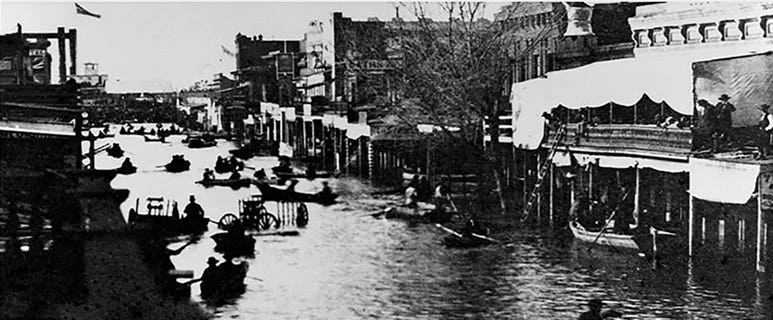
If you follow the news at all, I’m sure you’ve seen the stories about the atmospheric rivers that have picked up water from the Pacific (by evaporation) and dumped it along the west coast, causing “historic” and “catastrophic” flooding. Yet as serious as these downpours have been to those whose homes or businesses were swamped, you have to wonder what language the media will conjure up when a truly huge atmospheric river hits. The last such event inundated California’s Central Valley and surrounding regions with 43 days of rain that resulted in 15-20 feet of standing water; it created an inland sea 300 miles long and 20 miles wide. That deluge—known as the Great Flood—struck in late December 1861 – early January 1862, just after the Civil War had started back east. Thousands of people died and 200,000 cattle drowned. The capitol, Sacramento, had to move to San Francisco for six months, and the state went bankrupt for a while. Yet today, almost no one has heard about this superstorm, including those you’d think would be most aware of it: Californians.
Thanks for reading Ultra-Local, Full Circle Self-Sufficiency! Subscribe for free to receive new posts and support my work.
Turns out this was not some one-off catastrophe, but merely the latest in a series of Valley mega-floods over centuries, according to tell-tale sediment layers, some of which extended well out onto the Pacific ocean floor. Different accounts at various locations around the Valley—and all up and down the west coast—put the frequency of those floods at about once every 100-200 years.
Yet the 7 million people now living in the area formerly occupied by that inland sea have plenty of reason for concern. Geological evidence in rock sediments in the floodplain of the Sacramento River indicate that mega-floods comparable to that of the Great Flood, or much worse, occurred sometime during the spans of 1235-1360, 1395-1410, 1555-1615, 1750-1770, 1810-1820, and 1820-1862.1 Based on that data, geologist Michael Dettinger and paleoclimatologist Lynn Ingram, in a article that appeared in Scientific American, said that a Central Valley mega-flood had thus occurred about every one or two centuries, supposedly in line with other evidence.
But that’s grossly misleading, because the intervals between consecutive midpoints of those spans were 87, 183, 175, 55, and 47 years, for an average of just 109. Three of the intervals were less than 100 years, and two less than 56. So portraying the floods as occurring every 100 to 200 years is deceptive. At midpoints of 47 to 183, the floods actually occurred more like every 50 to 200 years, and 100 on average. And since the last mega-flood was 164 years ago, the Valley is 55 years overdue for the next one, according to their average occurrence. As if that weren’t alarming enough, climate change is now speeding up the potential frequency of California mega-floods by more than threefold.2
Take a moment to let all that soak in. (Yes, *soak*.) Would you bet the mortgage that, since the longest interval between mega-flood midpoints was 183 years, and the last flood was 163 years ago, then, whew, we’re safe for another 20 years? Honestly, would you actually think that way? Or would you be eying that average of 109 years between floods and the fact that we’re 55 years overdue for the next one? Astonishingly, for those living in the Central Valley now, the response has been California cool: Nah, we’re not concerned. In fact, more people are moving here all the time, with another million expected by 2030. We’re good.
Sooo . . . . despite the literally rock-solid geological evidence, over centuries, the reigning attitude of the populace appears to be What, me worry?
It’s too much to think about right now, we’ll worry about it when it happens
Uhh, right. Reminds me of a former governor of Wisconsin. When a reporter asked him a question he didn’t really want to deal with, he replied, “Oh, I’ll burn that bridge when I get to it.” That’s an apt mix of metaphors here, because cavalierly failing to prepare for an impending disaster is a way of burning your bridge to a more desirable (if not necessarily perfect) future. So let’s take a sober look at what would result from such bridge-burning, so to speak.
· Likely 7-8 million people will have to evacuate and not return for months or possibly years. The 1861-62 flood took 6 months to dry up.
· Also needing evacuation: about 5 million cattle, including over 1 million dairy cows; 5 million turkeys; and half a million sheep, among other animals such as chickens and horses. But if the flood unfolds at the rate it did in 1861, there won’t be enough time or resources to rescue most of them.
· 25% of the nation’s food will have to be sourced from somewhere besides the U.S. industrial food system, which simply will not be able to replace the flood deficit in a timely manner.
· Numerous industrial supply chains to and from the west coast will be severely disrupted, heavily impacting all areas of society in the U.S.
· The pollution would be staggering: from the massive feedlot manure pools of millions of livestock to the millions of rotting carcasses themselves; from toxic fossil fuels and by-products leaking out of 240,000 oil and gas wells; from the 200 million pounds of toxic pesticides and hundreds of thousands of tons of chemical fertilizer; and from mercury, asbestos, persistent organic compounds, molds, and soil-borne or sewage-borne pathogens.6 All of which, and more, would result in a toxic inland sea slurry that would leave residues too hazardous to safely return to—except for disaster workers in hazmat suits—long after the water subsides.
· The ensuing mega-disaster area will thus have to be cleaned up and infrastructure rebuilt at enormous effort and cost (on the order of $1 trillion), requiring many months if not years to get it under control.
· There will have to be a huge increase in do-it-yourself recovery efforts at all levels.
· Overall, it will make Katrina and similar catastrophes, including the Covid pandemic, look minor by comparison. Make no mistake, it will roll out as a reverberating national shock wave.
Bear in mind that several mainstream news articles have recently described the Great Flood, and how bad the next one would be1-5, so it’s not as if it’s all a big secret. The blinkered complacence that nonetheless prevails is thus apparently due to either blissful ignorance or a default mass burial of heads in the sand. Wow, is there any hope at all?
Several studies have been conducted or are underway to determine how to prepare for the coming deluge, regardless of when it arrives3,5,6. Still, plans to date by state and federal experts have been limited to managing water a little better, which have shown some success in re-directing flows during serious but far from catastrophic flooding events. In all fairness, the state is also trying to get ready for the next major earthquake, large scale fires, and brutal droughts, so they have their hands full. Besides, there’s only so much you can do to forestall a flood that threatens to fill up the Valley with 20 or more feet of water.
Left unaddressed sits the greatest potential for mega-flood damage control: fixing the corrupted and compromised condition of the land wrought by industrial ag and energy, the full shock of which the multi-tentacled pollution described above will reveal all too dreadfully. In essence, the toxicity of that mega-mess has already been deeply pre-baked into the flood aftermath by the business model of the juggernaut industrial food chain, and thus cannot be touched for now. Need proof? Recall that industrial food already externalizes about $2 billion in health, economic, social, and environmental damages every year. So ironically, only a mega-disaster will have the power to disrupt BAU industrial food. Will industry learn and start doing things differently, not only in California but also in the rest of the country? And if they do, will the world follow (or do it first)? We shall see. In any case, do you begin to grasp the scope of the challenge?
Enter the self-sufficiency garden food system
Fortunately, despite all our problems, we’re still a nation of (currently) 334 million creative, can-do, and optimistic people, with a lot of land. We will survive The Big One, even if, as will surely be the case, we wait until it happens before we start taking it seriously.
So how would self-sufficiency gardens help? Well, obviously, those in the Central Valley would get inundated by 15-20 feet of floodwater just like everything else. But if we have a nation-wide, robust, self-sufficiency garden food system set up by then, it would include a widely-distributed stockpile of stored food that we currently lack. Of course, how much would depend on how well established that system is when the mega-flood hits. But even if it’s providing only 25% of our food by then, it would constitute an extremely valuable resource that would help us recover from suddenly losing 25% of our conventional food supply. History has shown over and over that Americans are big-hearted when faced with a catastrophe, and I know that self-sufficiency gardeners would share their bounty, fresh or stored, with not only those fleeing the Valley but also the rest of the country, until we get back on our feet.
Supermarkets, which normally have only a three-day supply of food, would be of very little help, since they would be cleaned out almost immediately due to panic hoarding, with replenishment shaky at best. Again, we need a backup food supply, and a reliable way to continuously replenish it, and I don’t see anything but self-sufficiency gardens that, post-disaster, can do that on an adequate scale and in a timely manner. Even ordinary gardens, which grow mostly energy- and protein-deficient food, would help. As well, they can give us hope by example, since by cash value (but much less by calories and protein) they already provide about 10% of our food. We just need to ramp up.
Seen from this angle, a self-sufficiency garden food system becomes a matter of national security, able to build up (can’t emphasize it enough) a much-needed, decentralized strategic food reserve. It could also serve as an example for the rest of the world, which will be watching to see how we handle food replenishment following the next mega-flood. If they see us managing it well under the inevitable extreme duress, with an efficient and resilient alternative food system, it could inspire them to adopt similar systems. That is, assuming that by then they haven’t already figured out how to do so on their own. As indeed Russia has, although so far almost no one, including its own government, has publicly acknowledged its truly great value.
If anyone reading this is currently living in the Central Valley, I’d be interested to hear what you think of this post. And best of luck to you if you plan to stay there.
1Dettinger and Ingram, 2013. Megastorms could drown massive portions of California. Scientific American. January. https://www.scientificamerican.com/article/megastorms-could-down-massive-portions-of-california/
2Huang, X. and Swain, D.L. 2022. Climate change is increasing the risk of a California megaflood. Science Advances. 8:32. https://www.science.org/doi/10.1126/sciadv.abq0995
3Major, P., Jones, J., and Miller, B. 2022. A disastrous megaflood is coming to California, experts say, and it could be the most expensive natural disaster in history. CNN. https://www.cnn.com/2022/08/12/weather/california-megaflood-study
4Ingram, L. 2013. California Megaflood: Lessons from a forgotten catastrophe. Scientific American. https://www.scientificamerican.com/article/atmospheric-rivers-california-megaflood-lessons-from-forgotten-catastrophe/
5Philpott, T. 2020. The biblical flood that will drown California. Mother Jones. https://www.motherjones.com/environment/2020/08/california-flood-arkstorm-farmland-climate-change/
6Philpott, T. 2020. Perilous bounty – The looming collapse of American farming and how we can prevent it. Bloomsbury Publishing.

0 Comments