


Over years of perusing reports on AI’s challenges, both in product performance and financing, I’ve seen a steady increase in the number of economists and analysts who predict an AI implosion1,2,5-7. In fact, it’s now closing in on a consensus. What follows here is a mercifully brief distillation of the many factors driving a bubble pop, how it would impinge on the industrial food system and consumers, and how a garden food system would address the ensuing mess. I won’t even get into the fracas about whether AI inherently tilts good or bad, or has already spun out of control. That battle will be largely moot (at least for a while) if the whole enterprise collapses. As I believe it has to.
Why will the bubble burst?
Simple. It’s because hundreds of billions of dollars have been fed into the gaping AI investment maw, evidently way too fervently to justify its scant revenues so far. And there’s steadily fading reason to think that will change anytime soon. As a result, the tech titans—Microsoft, Nvidia, Meta, Amazon, etc.—have been burning through their coffers at an ever-quickening pace, spooking them into shaky accounting and circular financing. This is a risky money loop where major suppliers invest in AI startups that promise to buy products from them, or some variation thereof. Picture it: I’ll lend you money if you promise to buy my stuff, hoping it will benefit both of us, even though the sales potential is more hype than proven. Meanwhile, the upward swirling money vapors it stokes will help keep investment buzz at a fever pitch.
Even spookier, AI’s uber-expensive data centers gobble up enough power to supply large cities, provoking some communities and states to ban them. Analyst Edward Zitron believes that many of the planned or already built centers will never go on line.1 And even if some applications of AI survive a crash, many doubt that the next-generation versions will recoup the mountains of cash and ghost-investment being dumped into the maw.1,5 Yet despite all that, starry-eyed tech proponents still abound, shouting from the rooftops that AI is just too good to fail. Tulips, anyone?
Aftermath of the burst
Next step: Let’s suppose that this bubble does burst, as early as the fourth quarter of this year according to some analysists. In the short term, $trillions in AI investment will go up in smoke. How much will depend on when it happens (the longer the hype metastasizes, the greater the loss) and who gets left holding the bag. If the size of the burst is comparable to the dot-com bubble collapse of 2000, it would wipe out more than $20 trillion in American household wealth.2 This would likely prompt the Federal Reserve, in a bid to stabilize the economy, to rush huge amounts of cash into the financial system, just as it did after the 2008 crisis. That cash will disproportionately come from the taxpayer, who will once again bail out corporations (this time the tech bros) that are “too big to fail”. In essence, it will privatize the gains of wealthy risk-takers while transferring much of the loss to everyone else.2
It’s too early to tell whether a bubble pop would trigger a full-blown recession. We do know that Big Tech has been holding up (in more ways than one) the stock market for some time now with its largely fantasy valuations of AI. But stocks aren’t everything; there might be enough other basic strengths in the economy to produce a soft rather than a hard landing.3 Just to give a nod to the AI optimists.
Still, the burst is all but inevitable, and the aftermath will be another wealth transfer from the lower- and middle-income to the wealthy. But the re-direction of wealth doesn’t stop there. A big Fed bailout will increase the national debt, so we will also be transferring payment of bubble bills to the future. In any case, a lot of people will have a lot less money, including less to spend on food. And food, like almost everything else in an economic downturn, will become more expensive and harder to get for many, maybe most, people.
AI in the food chain
Let us now ponder how a bubble burst would impact the food system more directly. Al has been shoehorned into just about every aspect of the 1,500 mile-long food chain, although it’s hard to discern just how much it’s been applied to any one sector. That said, it’s clear that the primary goal of adopting AI is to boost the efficiency with which the industry’s flagship product line—ultra-processed-food—is sourced, produced, and distributed. That focus is pretty much a necessity, given that UPFs make up about 70% of the American diet. But it puts industry in the awkward position of using AI to make UPFs, the principal driver of obesity, more efficient to make and deliver to the consumer. When the bubble pops, AI will become less available, which will render UPFs less able to enhance the obesity epidemic. In as much as the industry would like to see positive outcomes (including reduced obesity), using less AI will be an obversely ironic way to arrive at their goal. By default, not intention. And to their exasperation, I would imagine.
The same conundrum applies all up and down the food chain. Recall that the industrial food system chalks up some $2 trillion in damaging externalities every year. Yet just as with UPFs, the primary reason to use AI is not to mitigate the damage, but to save money, which trickles down to producing the damage more efficiently. Reducing abusive treatment of farm workers and meat-packers, or restoring the declining socio-economic condition of local farm communities, or mitigating water and air pollution generated by livestock confinements, etc. are at most secondary (if at all) goals of AI.
On the other hand, industry will surely argue that making the industrial food chain more efficient can reduce external costs and damage. One example is precision agriculture, in which AI directs drones or satellite-enabled GPS to detect where fertilizer should be applied, then forwards the data to tractors. They, in turn, are programmed by AI to use the data to precisely deposit the chemicals only in needed spots and amounts, thereby reducing their use and helping the environment. In theory. Yet fertilizer application rates (in lb/ac) are about the same as they were 25 years ago, long before AI swooped down to the field.7 Meanwhile, the cost of fertilizer has shot up by more than 250% since 19868. Besides, it would take massive interventions, not the incremental nudges enabled by precision ag, to restore pre-industrial health to soil degraded by excessive chemical use. All while climate change is severely curtailing the amount of time we have for those nudges to add up. Would they even make a tiny dent in the annual $2 trillion in damages incurred by the system as a whole? If not, just where, precisely, is the proven consumer advantage of using precision ag? Given the industry mandate to produce harmful UPFs more efficiently, you could ask the same question about any other application of AI in the food chain.
A values shift
Impactful as they are, none of these factors takes into account by far the most consequential outcome of an AI bubble burst: the coming great values shift. This is because the whole AI buildup and probable collapse can arguably be traced back to the suite of basic values that undergirds our entire economic system. Agricultural economist John Ikerd identifies it as individual, short-term, financial self-interest10. Although there’s nothing inherently amiss with any one of the four elements, over-reliance on the mutually reinforcing mix has led to the plunder and pollution-driven, casino economic system we have today. That, in turn, has led to one boom and bust cycle after another, with ever more wealth being funneled to the already wealthy. To put it simply, an excessively me-first financial focus plays right into the hands of those most able and willing to accumulate wealth. High dividend-paying AI—hoped for by enthusiasts—would further enhance the current buildup and direction of wealth-flow.
People cling to their most life-defining values dearly, yea, fiercely. The only thing that can pry at least some of them away from maybe one of their values is an event so life-shaking that they’re forced to contemplate the unthinkable: What if this event is showing me that there’s something seriously out of whack with my values? What if it’s as much about me as the event?
I believe that mega-events with the power to make us re-evaluate some of our deepest values around food are barreling toward us with ever-increasing speed. It’s just a matter of which one first comes to the fore: climate change disasters hitting fiercely and often enough to wake us up? A nation-shaking mega-flood in California’s Central Valley? A drought-driven blowup of the big water war in the Southwest?9 Or maybe, as analyst Brian Merchant put it, “The [AI] bubble to burst them all”7? Or will it be some even more powerful combination thereof?
Right now, most people overwhelmingly value the seemingly lower cost and greater convenience of grocery store food over growing much to most of their food. Even when they have the space and wherewithal, they see gardens as taking too much time and energy to be worth it. But that will change. I posit that coming mega-events will spur a society-wide shift wherein we put less of our dearest value-eggs into the short-term, individual, financial self-interest basket, and more of them into the deeper connection to the earth, ourselves, and others basket.
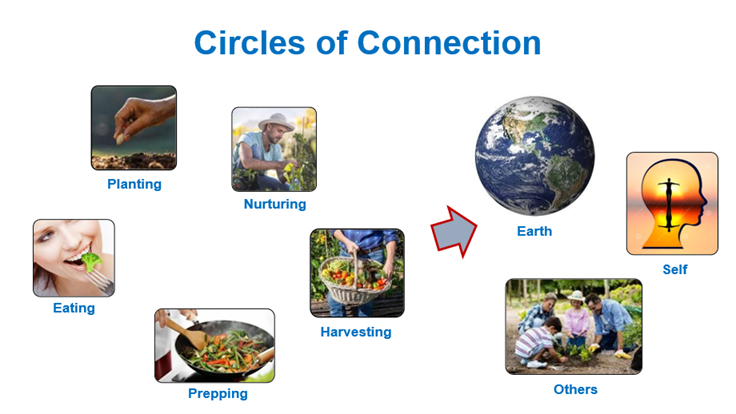
When deciding where to get the best deal, it will become a matter of shifting values: from grocery is best to garden is best. This shift entails a sort of mental wealth transfer, which is also a value transfer: away from the notion that you gain more from shopping convenience, and toward the idea that you gain more from producing directly from a garden. Put another way, it’s seeing that there’s ultimately more wealth value to be sourced directly from the earth than from that which sits in the store or bank, useful as those sources obviously are.
By no means does the wealth transfer to gardens apply only to food. In fact, as I’ve pointed out over and over, garden food, though fabulously healthier than UPFs and most other grocery fare, is not even what confers the greatest benefit. The source of greater wealth value is the self-empowerment and soul-enriching satisfaction that comes from re-energizing the golden-green (sun and plant) flow that cycles through planting, nurturing, harvesting, prepping, and eating—again, and again—only or mostly from a garden. And not just occasionally, but for continuous, extended periods of time. That’s what turns the trick, liberates the magic.
All of this, applied to hundreds of millions of self-sufficiency gardens across the country and around the world, will gradually help shift us, strengthen our human infrastructural integrity in ways that will reverberate throughout our entire society. Ways that we have been craving for, longing for, for a long time. It will be a fundamental transformation to what constitutes real wealth. Make no mistake, money and stuff will still be necessary, just not nearly as all-consuming, separating-from-self must-have as we’ve imagined them to be. So transfer some of your value eggs from the usual basket to that other, currently almost forlorn one. And less of your sustenance from the grocery and more of it from the nearby ground.* Shift. Shift. Shift. The sooner and more widely we do that, the better we’ll be able to forge our way through the coming phalanx of climate, technical, economic, and AI bubble-burst shocks.
*Yes, most grocery store food is also grown directly or indirectly (through meat) from the ground. But it comes from an average of 1,500 miles away, unlike the much closer distance between your garden and fork, and with no ultra-processing.
1Zitron, E. 2025. The enshittifinancial crisis. Where’s Your Ed At? https://www.wheresyoured.at/the-enshittifinancial-crisis/
2Roberts, M. 2025. The AI bubble and the U.S. economy. MRonline. https://mronline.org/2025/10/17/the-ai-bubble-and-the-u-s-economy/#:~:text=Businesses%20know%20this%2C%20which%20is,further%20into%20the%20labour%20market.
3Donovan,P. 2026. Anatomy of an AI reckoning. World Economic Forum – Chief Economists’ Outlook. https://www.weforum.org/stories/2026/01/how-would-the-bursting-of-an-ai-bubble-actually-play-out/#:~:text=With%20the%20initial%20financial%20market,a%20general%20sense%20of%20caution.
4Monaco, H. et al. 2025. Trends in fertilizer use and efficiency in the U.S. Illinois farmdocdaily. https://farmdocdaily.illinois.edu/2025/05/trends-in-fertilizer-use-and-efficiency-in-the-us.html#:~:text=Over%20time%2C%20nitrogen%20application%20rates,corn%2C%20soybeans%2C%20and%20wheat
5Doctorow, C. 2026. AI companies will fail. We can salvage something from the wreckage. The Guardian. https://www.theguardian.com/us-news/ng-interactive/2026/jan/18/tech-ai-bubble-burst-reverse-centaur
6Hsu, J. 2025. When it all comes crashing down: The aftermath of the AI boom. Bulletin of the Atomic Scientists. https://thebulletin.org/2025/12/when-it-all-comes-crashing-down-the-aftermath-of-the-ai-boom/?gad_source=1&gad_campaignid=22507971299&gbraid=0AAAAAC3qOh_VFu5ijUvHA68smhseS85o1&gclid=CjwKCAiAybfLBhAjEiwAI0mBBldRsXVAT7lkzbnGcZfA41lzBTJBmx3IkJ49S_De2gHNF66FAhbVaRoChHoQAvD_BwE
7Merchant, B. 2025. AI is the bubble to burst them all. Wired. https://www.wired.com/story/ai-bubble-will-burst/
8McCraken, J. 2024. GRAPHIC: Fertilizer prices reach a record high. Investigate Midwest. https://investigatemidwest.org/2024/01/18/graphic-fertilizer-prices-reach-a-record-high/#:~:text=by%20John%20McCracken%2C%20Investigate%20Midwest%2C%20Investigate%20Midwest,U.S.%20Bureau%20of%20Labor%20Statistics.
9Snider, A. 2026. The West’s water war arrives in Washington. Politico. https://www.politico.com/news/2026/01/31/west-water-interior-colorado-00756325
10Ikerd, J. 2005. Sustainable capitalism – A matter of common sense. Kumarian Press. https://www.amazon.com/Sustainable-Capitalism-Matter-Common-Sense/dp/1565492064/ref=sr_1_1?crid=1I4PG60WAI5CN&dib=eyJ2IjoiMSJ9.cOx5bcYOTkODV1MMPymmL2X_Q7n3kEJkCnSCly0kzq5XRUKAYxzwzSND1d20NdL2A4XMntUHv8TGgDX4ajwSKcNu7deRvxOxPon80PkcBzM.oDCEOmOw3zsBMMfAW5Q0m0hYO2_PLi0oSVi4Hmav6yI&dib_tag=se&keywords=John+Ikerd+Sustainable+Capitalism&qid=1770217662&sprefix=john+ikerd+sustainable+capitalism%2Caps%2C178&sr=8-1

0 Comments