

A few weeks ago I posted an article on how Michael Pollan, the long-time famous writer in favor of all food things natural and regenerative, was ostensibly at odds with best-selling author Michael Grunwald. He holds that Pollan’s approach is less environmentally friendly than that of industrial. Why? Because it produces higher yields, thus using less land and pumping out less carbon emissions, therefore contributing less to global warming. All while producing more food. I called them Michaels 1 and 2, respectively, and showed how self-sufficiency gardens—as I envision them—would be a win for both.
Much to my surprise, Michael 2 responded almost immediately with a comment:
“Great post! I agree gardens are great, and it’s true high-efficiency industrial ag hasn’t prevented all land-clearing, partly because livestock (especially ruminants) are inherently inefficient. But high yields are really important; if the Green Revolution hadn’t tripled yields, we’d need 3X as much land to produce the same amount of calories. And right now 3/4 of all ag land supports livestock; that’s a problem gardens (which, again, are great!) can’t solve.” Best, Michael 2
That’s on-point, honest, well-informed, and conveying every intention to be fair-minded. Just what I’ve come to expect from reading his book, We are eating the earth – The race to fix our food system and save our climate (2025), and listening to several podcasts in which he was featured. Not that I agree with him on everything. Still, what do we do with his contention that three-fourths of all ag land supports livestock, forcing us to prioritize high yields, which is a problem gardens can’t solve?
At first glance, it sounds unarguably persuasive. Yet it’s based on three shaky assumptions, namely, that: 1) industrial agriculture can avoid or adapt to the accelerating pace of climate change shocks; 2) meat consumption will continue to trend upward no matter what; thus 3): there’s nothing gardens can do about 2), since [by implication] no one is going to raise livestock in their backyard. The related reference to Green Revolution yields needs a separate treatment, but first, let’s take a sober look at those assumptions.
1) We don’t need to take the rapid increase in disasters seriously.
It’s not that industrial ag hasn’t noticed climate change. They’ve been boasting for some time that they’re revving up “climate-smart” tech and new crop strains to more efficiently use fertilizer, withstand drought, fight off new pests and heat, increase yields, etc. What they don’t consider is that climate change disasters are ramping up much faster than industrial fixes can be globally scaled, especially for the outsized demands of livestock production. Those retrofits are geared to fit an imagined gradual climate change, not the actual, rapid pace at which enviro-disasters are marching into our lives. And we don’t have the time to wait around for slow fixes. But wait around is clearly what industrial ag intends to do. What that amounts to is a pernicious second level of climate change denial: not denying outright that it exists, but that it’s so gradual or un-serious it won’t threaten our food supply.
2) Global meat demand will continue to rise, rapid climate change be damned.
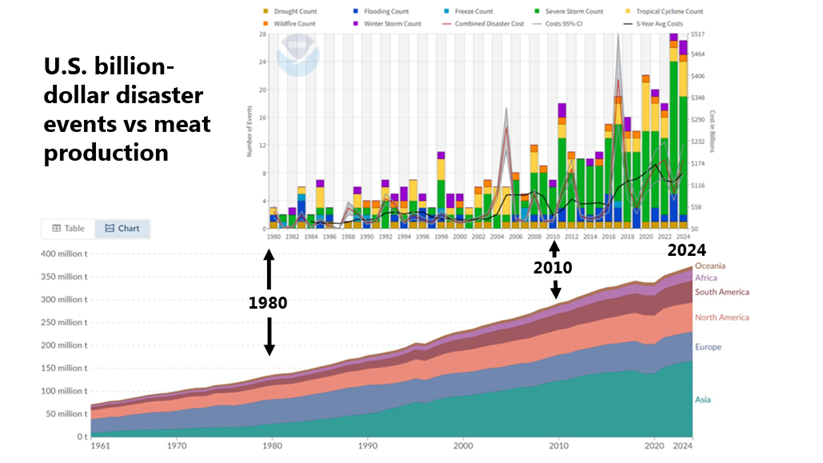
Yet the increasingly rapid rollout of disasters is serious. Very much so. I’ve shown the following NOAA graphic—which shows the increase in U.S. billion-dollar disasters since 1981—several times. Here it is again, this time compared to the rate of global rise in meat production since 1961.

Precisely because livestock commands three-fourths of ag land, in addition to huge slices of the water and energy we use, it’s much more vulnerable to the heat waves, floods, drought, fires, and aquifer depletions than the non-livestock sector. Notice how fast billion-dollar disasters have increased since 2010, and imagine how that spiral will continue ever upward over the next 25 years. Already, the first six months of 2025 were the costliest on record for U.S. weather disasters.1 Now look at the rate of meat production2. Though rising at a much slower rate than disasters, it’s unsustainably high-volume. In other words, the slopes and contexts of these two trends are on a collision course. Something’s gotta give, and it won’t be climate change. Meat production? Well, consider a sector that burns through resources as ravenously—and on a scale as vast as—livestock. Could it defy ever-intensifying eco-shocks until 2050?
Highly unlikely. It’s thus unrealistic to expect that the production of meat will be able to splurge at its current rate from here on out, regardless of demand. At some point—when multi-billion dollar disasters begin to overlap enough to be intractable—climate change will begin to choke it off. As Günther Thallinger, board member of Allianz SE, one of the world’s largest insurance companies, puts it:
“No governments will realistically be able to cover the damage when multiple high-cost events happen in rapid succession, as climate models predict.” 3
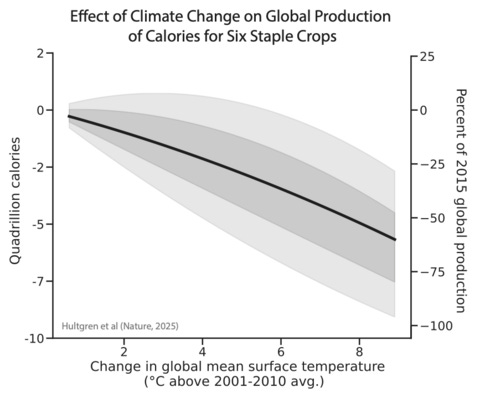
At that point, we’ll be forced to start using less, not more and more, land for livestock. Which means that from then increasing yields primarily for livestock will be a moot point. Not convinced? Below is a graphic from the most comprehensive study to date on how agriculture will respond to climate change, published in the prestigious journal Nature in 2025. It reported on observations from over 12,000 regions across 55 countries, analyzing adaptions for costs and yields that supply two-thirds of global calories from six staple crops: wheat, corn, rice, soybeans, barley, and cassava.4 It concludes that by 2050, crop yields will decrease by 11%, just when Michael (correctly) says we’ll need to produce 50% more food to feed 10 billion people. The combined accounting adds up to—or rather down to—a shortfall of 61%. Nor was the Nature study a one-off. Slightly earlier (2021) research projected the probability of rice, soy, maize, and wheat yield failures to be as much as 4.5 times higher by 2030 and up to 25 times higher by 2050 across global breadbaskets.5 Other accounts, as Michael noted in his book, tell a similar story. No way industrial agriculture, especially livestock’s grab of 3/4ths of its total land, can continue BAU until 2050. And maybe not even until 2030. Even with hoped-for tech fixes and yield increases.
Nor is it just a future worry; it’s already threatening the U.S. cattle industry in the U.S. Southern Plains:
“Large swaths of Oklahoma, Texas, and beyond have been locked in severe drought conditions . . . This cost the agriculture industry in Oklahoma, Texas, and Kansas an estimated $23.6 billion from 2020 to 2024. In 2022 alone, 25% of Texas corn went unharvested, 45% of soybeans were abandoned, and 74% of the cotton crop was lost. Ranchers have been forced to sell off cattle because dried-out rangelands can’t support grazing.”6
So it’s not a matter of replacing industrial livestock with a cow or pig in every garden, although a couple hens are often doable and would help. It’s that climate disasters will seriously knock back the rate of livestock production—and soon—thus reducing its voracious appetite for land and other resources, gardens or no. Of course, the non-livestock sector will also be affected, but because livestock occupies three-quarters of the total, it will take the brunt of the setback. Meanwhile, self-sufficiency gardens, because of proximity to personal care, are much more resilient to climate change. As a result, they are well-positioned to cover the deficit caused by climate change rollback of livestock. See next.
3) Gardens can’t help—at least not in the way that first comes to mind.
Right again—at first glance: no livestock amongst the tomatoes and zucchinis. However, properly managed, gardens drastically reduce the average amount of land required to feed one person: from industrial’s 3 acres to self-sufficiency gardens’ 0.03 ac, a hundred-fold reduction. Highlighting their inherent scalability, Russia’s household gardens supply 50% of its food on just 3% of its agricultural land7. Garden food footprints like these, even if applied only to the non-livestock sector, would free up enormous amounts of land that could then be re-purposed to natural vegetation. As Michael has correctly noted, established wetlands, forests, and prairies absorb much more carbon—acre for acre—than industrial (and even regenerative) agriculture. Implementing such an ag-for-nature swap would, while making more food on less land, amount to a beneficial “indirect land-use change”*, free and clear of livestock. It would also represent a vast net yield increase, though in a nation-wide network of highly productive self-sufficiency gardens rather than solely in agricultural monocultures. So yes, gardens would feasibly mitigate the need for higher industrial yields and more land—especially for livestock—just not in the way and for reasons you might pre-imagine.
I can’t emphasize it enough: the real economy of scale, when it comes to large-scale food production and consumption, accrues not to the industrial model, with its extreme inefficiencies, but to an extraordinarily efficient self-sufficiency garden food system. When you comprehensively compare the two as whole systems, the pertinent facts and numbers don’t mislead, nor do the full-scope contexts and major metrics of efficiency. Missing out on the garden option amounts to an opportunity cost of using far more agricultural land per capita than is optimal.
The Green Revolution
Michael is also right when he said that if the Green Revolution hadn’t tripled yields, we’d need three times as much land to produce the same amount of calories. But yields and calories alone don’t capture the full scope of the challenge. For one thing, increasing industrial yields enough to feed the world in 2050 would only exacerbate the already-unsustainable global obesity epidemic with ever-more ultra-processed foods, currently at 70% of the American diet. As it would a number of other equally unsustainable pitfalls of an industrial food system on sky-high yield steroids.
Green Revolution proponents claim that those higher yields “saved” hundreds of millions of people from starvation. Critics like Michael Pollan, on the other hand, say they simply enabled that many more people to be born. Which, sans solving world hunger, is not exactly a commendable plus. Even Norman Borlaug, the great developer and “Father” of the Green Revolution, admitted that higher yields didn’t solve world hunger. Rather, it merely “bought time” to address the “population monster.” Fifty years later, that monster is still haunting us, and it will be even harder to resolve now that we have a second, even scarier monster. That would be—already is—climate change disasters, which will further confound the industrial food system. In short, increasing industrial yields didn’t solve food insecurity in the past, and is even much less likely to do so in the future.
As a wrap, I remember Michael mentioning in his book that Tim Searchinger, his go-to enviro-lawyer-come-scientist consultant, had said he was searching for any way to greatly push up yields without massively expanding ag land. Evidently, he missed the full extent and significance of the Russian garden performance.7 If it works at scale there, why couldn’t it here? I think he would be pleasantly surprised if he looked into it with his usual care.
* * *
*Indirect land use change typically refers to the increase in carbon emissions due to land-use changes around the world. They’re induced by redirecting croplands formerly intended for food to ethanol and biodiesel production in order to meet fuel demands.
1Bush, E. 2025. What canceled climate data would have shown: The costliest 6 months of weather disasters on record. NBC News. https://www.nbcnews.com/science/climate-change/climate-change-data-costliest-6-months-weather-disasters-noaa-rcna238752
2UN FAO. Total meat production, Global Meat Production 1961 to 2024. Our World in Data. https://ourworldindata.org/grapher/global-meat-production
3Carrington, D. 2025. Climate crisis on track to destroy capitalism, warns top insurer. The Guardian. https://www.theguardian.com/environment/2025/apr/03/climate-crisis-on-track-to-destroy-capitalism-warns-allianz-insurer?CMP=oth_b-aplnews_d-1
4Garthwaite, J. 2025. Climate change cuts global crop yields, even when farmers adapt. Stanford / DOERR School of Sustainability. https://sustainability.stanford.edu/news/climate-change-cuts-global-crop-yields-even-when-farmers-adapt#:~:text=The%20study’s%20authors%20found%20that:%20*%20Every,24%25%20if%20emissions%20continue%20to%20rise%20unchecked.
5Caparas, M., et al. 2021. Increasing risks of crop failure and water scarcity in global breadbaskets by 2030. Environmental Research Letters. https://iopscience.iop.org/article/10.1088/1748-9326/ac22c1
6Hindman, S. 2026. Experts issue warning as historic crisis threatens US cattle industry — here’s what’s happening. TCD. https://www.thecooldown.com/green-business/southern-plains-drought-impact-agriculture/
7Sharashkin, L. 2008. The socioeconomic and cultural significance of food gardening in the Vladimir region of Russia. PhD dissertation, University of Missouri. chrome-extension://efaidnbmnnnibpcajpcglclefindmkaj/http://naturalhomes.org/img/food-gardening-russia.pdf


0 Comments