

Now suppose you’ve had success with a starter garden (producing enough food to consume a balanced diet for at least one full day, and probably for longer) and want to expand it the following year. You may or may not have an eventual goal of a garden productive enough to live from it for a year, but a gradual buildup is much better than a sudden jump to the next level, whatever that may be for you. Unless we have a total meltdown of the industrial food system over the next year, so that you’re motivated more by need rather than a comfortable expansion rate, I suggest a second year of no more than 2-3 times the size of the starter garden. Here are some of the new elements that come into play with a larger garden.
Fencing
Even with just a four-foot high fence, it’s extremely unlikely that deer will jump into a starter garden enclosure measuring just 5.5’x18’, especially if you have some kind of vertical supports for tomatoes and pole beans. It’s just too confined and crowded for them to feel safe. However, with increasing size they become less easily spooked about jumping over a fence, which means you might need to extend the top to five feet. It really depends on how hungry they are. I went for years with only a four foot-high fence and had no deer problem; then suddenly one year, late in the season, they jumped it. Still, the more you fill up the interior with vertical objects like lines of pole beans, trellises for beans, some kinds of winter squash, and even sweet potatoes, the less likely they are to feel safe in there. And I’m talking about the white-tailed deer that are common in the eastern half of the country. I have no experience at all with mule deer in western states. It’s a good idea to talk to gardeners in your area about what it takes to keep them out.
As for rabbits (the eastern cottontail), the most important deterrent is a four foot-high, one inch-cell chicken wire. Even then it’s best to extend the lower edge out to form a three-inch wide flange down flat against the ground, around the outside, to discourage them from digging under the bottom edge of the fence. And it’s best to do all this before you plant anything. I’ve suffered deer and rabbit raids more than once when I didn’t get a fence up early enough.
Bed spacing
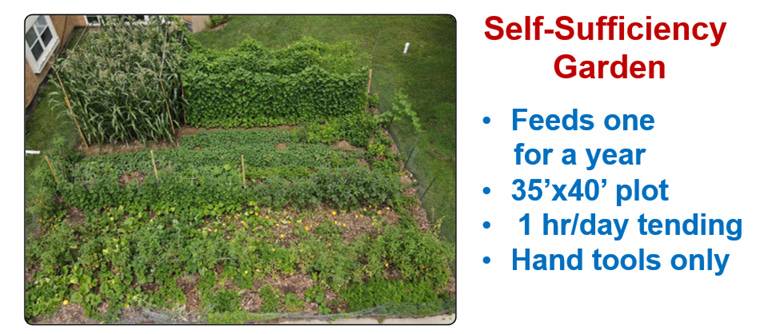
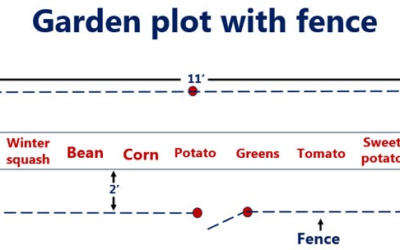
In my 35’x40’ gardens, which supply a year’s worth of food for one, I have ten rows of 1.5’x40’ beds, with two foot-wide aisles between them. I also plant some extra, vining crops along some of the perimeter fence if the leaves poking through the fence are not tasty enough to serve as a snack buffet for deer or rabbits. So no sweet potatoes there, the leaves of which are like candy for them. Then, when increasing planting space, it’s better to go blockier than longer. For instance, if you go from one to two 1.5’x14’ beds, it’s better to put them side by side rather than end to end. The reason is that there is less fencing increase to deal with. A year or two later, you may want to have the equivalent of six starter gardens, in which case two adjacent rows of three starter-sized beds end-to-end might be the best arrangement. Or you might decide you want 2’-wide beds, and 3’wide aisles. Fine, as long as you’re prepared to deal with more fencing, mulch, compost, watering, and soil prep. I’m just describing how to get the most out of a 35’x40’ garden area with the least amount of effort.

Arrangement of plants
In contrast to a starter plot, the larger the garden, the more plants of a particular kind you’ll place together; it wouldn’t make much sense to have four starter gardens side by side, each with seven different plants. However, there are many strategies and preferences for plant arrangements, as well as variations in crop rotations from one season to the next. As just one example, see below for the way I interplant greens and tomatoes. This is more a matter of convenience than companion planting, wherein two adjacent different crop plants have an advantageous effect on one another. In general, I prefer plants in a given row to be of just one type.
Nutrition proportions
Although it’s not that easy to do with a starter garden, growing a garden that delivers a balanced diet becomes easier with increasing size. In general, I aim for a layout in which about one third of the growing space is devoted to protein production, one third to carbohydrates, and one third to all the other components of balanced nutrition. Again, this is so very different from the usual home garden, which focuses almost entirely on juicy veggies low in protein and carbs. Protein comes mainly from dry shell beans, but there is also a fair amount of it in dry corn and even, surprisingly, potatoes if you eat them regularly. (Did you know? Dried potatoes and dried human milk have the same amount of protein per unit weight.) Carbohydrate-dense crops are mainly corn and sweet potatoes, with potatoes and some of the drier winter squashes not far behind. Of course, beans and corn also provide a number of other nutrients in addition to protean and carbs.
Water
Vegetable gardens require an inch of water a week, according to just about every authority on gardens. But sandier soils will need more than heavier clay soils, so it varies. When you have only one or two 1.5’x14’ beds, it’s not too arduous to water with a watering can. Maybe even three or four such beds, depending on how far away your water source is, and how often you need to water. As you get a larger and larger garden, however, at some point it will be wise to use drip irrigation. Or if you don’t mind lugging a garden hose around, that can work too, but again, only up to a point. Also, if you pack a good six inch-thick layer of dense mulch around your crops, and in the aisles as well, you won’t need to water nearly as often as you would if you left the soil bare, which unfortunately many people do. Plus, the mulch keeps the weeds down, and it also gradually becomes compost, enriching the soil. Can’t say enough good about mulch, as long as it doesn’t consist of wood chips.
Hauling stuff around
The larger your garden gets, the more handy it is to have a small wheelbarrow to transport compost, mulch, and if you need to, topsoil for a raised bed. Note that I said small (4 cubic feet), not one of those awkward big ones, and certainly not a square-sided cart. That is, unless you don’t mind increasing the width of your aisles enough to accommodate all that goes with it, as noted above. A small, single-wheel barrow allows you to turn sharp corners, allowing you to keep your aisles to 2’ wide while easily getting to all parts of the garden with not-too-heavy loads.
Corn
You will remember that I said a single or two corn plants need to be hand-pollinated. However, that won’t be necessary once you’ve graduated to at least four rows 10’ long, which you’d plant side by side (with the usual 2’-wide aisles). At that point, you can let the wind do the pollinating. This is one case where I recommend jumping fairly substantially from a small number of corn plants to the 10’-long rows, as hand pollinating can get to be a real chore if you have to tend to more than a very few of them.
Beans
To make the best use of space, I strongly suggest dry shell pole beans. This means you have to provide some way for them to climb up a trellis, strings, or slender poles, and there are a number of ways to do that. I grow an heirloom variety that climbs up eight feet or more, forming a thick curtain of vines. In order to keep them from shading one another, I now don’t grow them in adjacent rows, though with just a few plants shading is not an issue. You can, of course, grow dry shell bush beans only a foot or so high, but pole beans usually yield better, and the vertical orientation they require also helps to spook deer into staying out of the garden, as well.
Winter squash and sweet potatoes
These are both characterized as vines that like to sprawl along the ground, and they will certainly do that if you let them. However, you can put up 4’-high, 2”x4” welded wire fencing along the row, and train the vines up into as lattice, thus making better use of space. That’s easier to do with some winter squashes than others.
Tomatoes and greens
I space tomato plants 3’ apart and put a Swiss chard or kale plant between each two tomatoes. The greens, which like cool weather, grow and yield well while the tomato plants are still gradually gearing up, but at some point the tomatoes start to more or less shade out the greens, so I then harvest most of the chard or kale leaves. However, toward the end of the summer the tomato plants start to max out, so I eventually remove them, giving the greens enough light to have a second spurt of growth and yield that extends well into the fall, even early winter.
Other high-yielding veggies
Think green beans (which also have significant amounts of protein, though not nearly as much per unit fresh weight as dry shell beans), okra, carrots, onions, and rutabagas. Also, I’ve found that loki (a.k.a. lauki) squash is a prodigious producer, requiring only a couple plants (provided with plenty of compost and water) along a perimeter fence. The deer and rabbits won’t bother it (beyond an exploratory nibble) if some of its leaves emerge through the fence. Which, due to the heavy vines and leaves these plants generate, needs to be either stout enough (e.g., 2”x4” welded wire, 4’ high), or, if you’re using chicken wire, more closely spaced T-posts for extra support.
I know that many people love their lettuces for salads. Yes, they can be delicious, but compared to almost all other garden vegetables, they offer very little in the way of nutrition for the amount of room they occupy. Then there are a number of other watery favorites like cucumbers, bell peppers, zucchinis, summer squash and radishes. Fresh or canned sweet corn, though somewhat watery, does provide some 500 calories per pound, about the same as sweet potatoes. Nevertheless, they need only about a third of the 1,500 calories per pound you get with dry shell corn in the same amount of garden space.
Preservation for the winter
There are many videos and other resources for how to preserve garden fare, so here, I’ll just mention the five major ways to do it: dry storage, canned, frozen, pickled, and dehydration. These days, canning is much, much easier with one-step electric canners, and you can now even buy vacuum-packers as an additional way to preserve at least some foods. Other than that, once you get beyond starter garden status you need to think about storage space, which depends on what and how much you choose to grow. Extra space in your kitchen cabinet or pantry for dried beans and corn? A basement cool room for potatoes and other root crops? A small room with beaucoup sturdy shelves for canned or pickled goods? An extra freezer, and a place to put it? And if you favor that route, do you need a backup generator or solar panel and battery in case of a power outage? Many variables, many possible routes to think about, which is another reason to ramp up gradually with your garden efforts.
Above all, recall again the gold rule of gardening: If you’re not having fun with all aspects of it, you’re thinking or doing something wrong. Joy is key.

0 Comments