

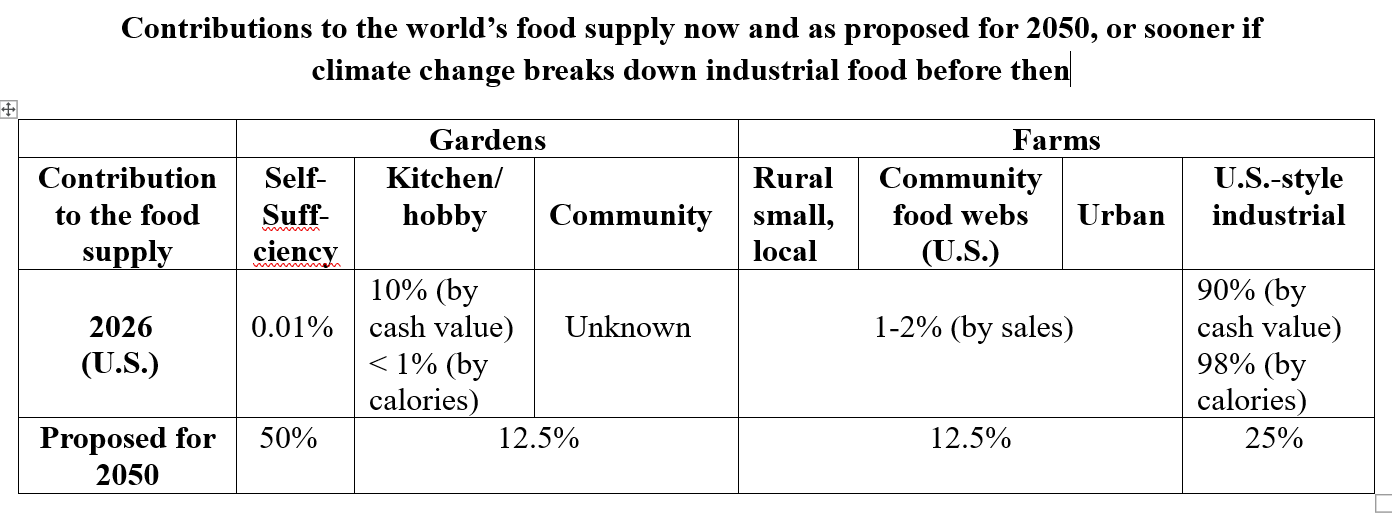
I’ve said all along that to feed 10 billion people by 2050, self-sufficiency gardens will need to provide about 50% of our food supply. But what about the other half? According to my expert analysis, 25% would come from Local Food sources, with New Industrial providing the other 25%. Except that, oops, these percentages are actually WAGs (wild-ass guesses), not informed estimates or predictions. There are just way too many unknowns and fast-moving world events to be any more precise right now. So much for expertism.
Now, to drill down, we know what self-sufficiency gardens are, and what U.S. industrial food hangs its hat on: 70% ultra-processed foods. But just what exactly is local food? Unfortunately, the term can include household gardens, community gardens, community food webs, small local farms, and urban farms, all under the umbrella concept of urban agriculture. This makes it hard to parse out just how much comes from gardens. Yet it’s something that would be helpful to know, given that critics might say, well, look at all the food already supplied by gardens, especially in developing countries, and they’re still starving. Ostensibly because of how inefficient gardens and local are compared to the industrial model. Which, by the way, has itself failed to solve hunger at scale over the long term.
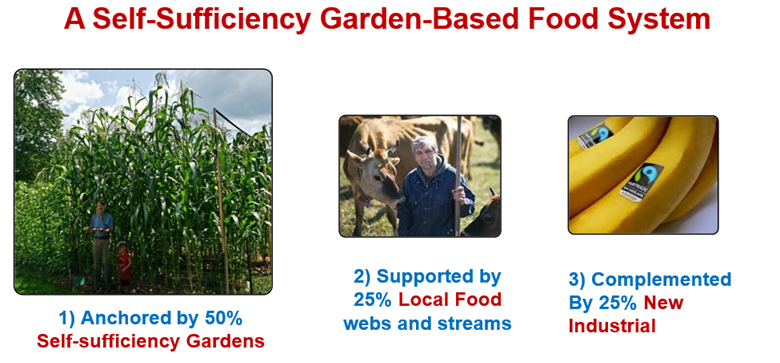
That brings us to the purpose of this post: to assess how well local food sources and New Industrial can help to feed that 10 billion by 2050. Or, as now seems likely, mitigate a rapidly worsening food crisis well before then. By New Industrial, I mean whatever altered state of functioning the industrial food system has evolved to by 2050, or sooner. For sure, its current iteration is too deeply non-sustainable in too many ways to continue indefinitely. Nevertheless, it has to find a way to endure in some form or other, at least for the foreseeable future, just because of the many people who live in very high-density city housing; they have no quick way to shift to food from gardens or local/urban farms. For the U.S., they make up at least 10% of the population. Fortunately, about 23% of American urban areas is occupied by lawns, which could transition to enough self-sufficiency gardens to feed their urbanites. For city-states like Singapore and Hong Kong, the packed-in are more like 95% of the population, so they would be far more challenged to feed themselves.
Gardens are not small farms
By my definition (and that of others1), household gardens supply food for a family, whereas farms provide food to be sold for profit outside of the household. There can be some overlap, as extra produce from the largest gardens may be sold to supplement family income, and a portion of the smallest farms’ output may feed the farmer’s household. This crucial distinction sets us up to wade through the tangle of local and industrial food, now and as proposed for 2025.
All of these options will be assessed according to the criteria of self-sufficiency gardens, as they:
-
Can provide food security over the long term.
-
Are feasible from the individual person to massively collective scales.
-
Provide a balanced diet.
-
Greatly reduce use of natural resources.
-
Can be scaled relatively quickly, cheaply, and easily.
-
Are globally applicable, though in varying ways by region.2
-
Maximize resilience to climate change due to close proximity to personal care.
U.S.-style household and community gardens
Kitchen/hobby gardens, U.S. style, average about 20’x30’ and as previously mentioned, grow almost entirely watery vegetables low in protein and energy. Hence, they rarely provide a balanced diet. That said, both they and community gardens satisfy pretty much all of the other criteria, at least conceptually. The average U.S. community garden consists of a collection of raised beds tended by individual gardeners. However, some of these gardens are much larger, perhaps a quarter acre or so, and are maintained by a team of volunteers who often donate their harvest to nearby communities.
Although both kinds of gardens provide significant amounts of food, my read is that they can’t ramp up quickly enough to solve the hunger problem on their own. It’s one thing to produce, as one study shows, 0.6 pounds of food per square foot3 (which is about the same yield rate as my self-sufficiency gardens) but quite another to duplicate that effort on enough raised beds to feed a person for a year. In Eastern Europe and in developing countries, home and community gardens likely produce more per capita than in the U.S., but they still fall short of resolving food deficits. Nevertheless, about 40% of U.S. households already have gardens of some kind, which produce about 10% of the food supply by cash value (though only 1% by calories). That is a quite significant base to build on.
Farms
First, understand that the first three types of farms—rural small local, those in community food webs, and urban—can overlap with the fourth (industrial) and thus either compete with or strive to market through the industrial food system. They vary from farmers markets to CSAs (community supported agriculture) to food hubs to food webs characterized by local networking and processing. Some aim to sell only locally, whereas others may include local but do the main part of their business in national markets. And some may be a half-acre fresh produce farm while others are hi-tech greenhouse operations that grow greens in banks of vertically arranged trays under LCD lights. Aquaculture, hydro-culture, in-ground, and other types of greenhouse production also fit into the urban farm category, regardless of whether they join—or avoid—the industrial food chain.
Most of the time, these small farm or food-web type networks have to either sell less than enough to net their owners a living, as with farmers markets or most CSAs. Alternatively, they may charge enough to sell to high-end customers who can afford to pay more. Or they may go full-tilt industrial in a niche market that has small margins but enough volume to successfully market nationally. I’ve seen examples of all three. Of course, even most conventional farmers don’t earn enough on their farms to make a living, so they have to take a second job. Larger farm size doesn’t guarantee a comfortable income, especially in these increasingly dire times for farmers.
Still, in general, the smaller the farm and its preferred market, the more difficult it is to compete with the industrial food system, which is allowed to throw off some two-thirds of its true costs as externalities. Smaller operations simply can’t externalize as much of their costs, and often don’t want to anyway, preferring to turn out safer, higher quality, and fresher food instead. Even if it shrinks their sales potential, which it almost invariably does. It’s not a level playing field.
All of that said, both gardens and the various types of local farms—despite together accounting for only 2% of total food sales in the U.S.—still have the potential to turn out much more food than they do now. They just never give up, and you have to admire them for that. And they probably would produce a good bit more food if, as looks increasingly likely, the industrial system starts to seriously fall apart. As currently structured, it just can’t hold together indefinitely in the face of climate change disasters, wars, and severe fertilizer and pesticide shortages.4 Fortunately, the learning curve for massively ramping up self-sufficiency gardens is much cheaper, quicker, and easier to implement than similarly scaling up any of the alternatives.
The New Industrial conundrum
I’ll say it again: if the current arc of bad news for industry continues unabated, it simply will not be able to produce food at its present, extremely inefficient rate much longer. Somehow, it has to do something truly new. It’s already hemorrhaging in Africa and parts of Latin America and Asia, and will eventually land very hard on all of the many densely populated megacities around the world. And even if, as I expect, we transition to half of our food coming from self-sufficiency gardens, there is still a (WAG) quarter of it that has to come from ordinary gardens and small local urban farms, which are not very amenable to feeding dense populations. So how in the world will the tentative final quarter—New Industrial—feed those tightly-packed inner-city denizens?
To be sure, champions of the industrial system still believe that, when pushed, it can ride to the rescue. In an otherwise excellent and comprehensive article on the food system “poly-crisis,” global food system analyst Craig Tindale4 says:
“History demonstrates that when confronted with severe input and climate shocks, markets, farmers, and governments respond with speed through strategic reserves, emergency policy interventions, accelerated adoption of precision agriculture and drought-tolerant genetics, black- and grey-market arbitrage, and partial supply-chain substitutions.”
Trouble is, the relatively short history of industrial agriculture does not include anywhere near the rate at which the scale, intensity, frequency, and cost of climate change disasters are now simultaneously accelerating around the world. It’s unprecedented, a whole new ball game, and Tindale’s adaptations, which may—debatably—have worked in the past, will be woefully inadequate to address the coming global food deficit.
So again, even if self-sufficiency gardens provide half of our food, and another quarter comes from other urban agriculture, the remaining New Industrial quarter still won’t meet the food needs of the densely packed city-dwellers. Think, for example, 23 million in Greater Mexico City and 37 million in the metro area of Tokyo. I’ve ruminated about this conundrum—you could even say it’s a “wicked problem”—till my brain felt fried, and the best I can come up with for these folks is: 1) those who can afford the coming much higher food prices of New Industrial will stay in the cities and pay up; whereas 2) the many more who can’t afford to stay will have to leave or starve. Eventually, they will number in the millions; it will be a worldwide, mega-city out-migration. I truly don’t see any way out of it.
Where will these hungry souls go? Anywhere they can to get food. In some cases, they’ll flee to nearby but less crowded urban areas, where gardens and urban farms will supply food unavailable in the denser areas of the city. In other cases, it will be to even less populated areas (or countries) where they can grow their own food. At some point, alarmed governments will rearrange their priorities and step up to help people move and afford to live in rural areas so they can grow their own food. But that will happen only when things get really, really bad, and the above fantasy adaptations clearly aren’t working. Conveniently, such moves will also address other pressing concerns, as many overpopulated cities are either sinking or are increasingly exposed to rising sea levels, or are fast running out of fresh water.
So that’s my read, at least for now, on how global populations will respond to the coming food system shocks. Hang on, it will be quite a hair-raising, nail-biting ride.
~
1Boukharaeva, L. and Marloie, M. 2015. Family urban agriculture in Russia. Springer
2Brown, K. 2026. Tiny gardens everywhere. Norton.
3Algert, S. et al. 2014. Vegetable output and cost savings of community gardens in San Jose, California. Journal of the Acacemy of Nutrition and Dietetics. https://www.sciencedirect.com/science/article/abs/pii/S2212267214002329
4Tindale, C. 2026. Substack. War, El Niño, Pestilence, and Famine: The Coming Shock to Global Food Supplies
0 Comments