

I always like to put myself in the shoes of those who say no way self-sufficiency gardens will rescue the beleaguered industrial food system. Just to remind myself of their viewpoint and address their concerns. One issue they’re sure to harp on is the “big four” mass-produced staples—wheat, corn, rice, and soy—that provide 60% of the world’s food calories. All by the wondrous machine of industrial agriculture. Untold suffering and famine would ensue without those mainstays. And for sure, we can’t replicate their calories with mere gardens. Nor could we ramp up enough lesser staples like barley, cassava, sorghum, and potatoes to make up the difference. Not industrially, and certainly not in backyards. So much for the idea of gardens as a solution to global hunger. Right?

Wrong. But to see why, you have to broaden your vision to encompass what the industrial narrative so badly misses.
So, let’s first unpack this seemingly airtight argument that we must continue to mass-produce those four industrial crops. Then we’ll see what self-sufficiency gardens can offer as an antidote to industrial ag. Hopefully before it gets dismantled by environmental disasters.
Before we even get started, remember: I’m not proposing that gardens should replace the industrial food system overnight, or outright. I’m saying let’s galvanize a sensible parallel food system that will sort out, at consumer discretion and timing, how we eat as we stumble further and further into the age of climate change.
How much of the world depends on industrial production of the big four calorie crops?
It all begins with the default assumption—of our entire culture—that large industrial farms are the only feasible way to produce food at scale. Yet they account for as little as 30% of the world’s food production, or as much as 70%, depending on whether you believe the UN’s long-standing estimate prior to 20184, or that of two more recent research articles,1,2 respectively. This means, per the low estimate, that as little as 30% of global food comes from “small-holder” production, usually defined as farms of less than 2 hectares (5 acres), in addition to gardens and wild-caught food. Or, if you go with the high estimate, as much as 70% of it comes from these very small, local sources.
Farms are not equally industrialized: globally, the smaller the farm, the less likely it is to have any mechanization at all, as draft animals pull the plows on 50% of the world’s cultivated areas, and account for 82% of mechanical power in Africa3. Most farms are small (200 ha or less) to very small scale (less than 2 ha), and make do without a tractor. Or, families tend gardens with nothing but a grub hoe, and/or hunt, fish, and gather.
Yet even the lowest estimate of 30% would produce food for a whopping 2.4 billion people (30% of the world’s population) who get by without large-scale industrial production of big four calories. Might, then, the other 5.8 billion of us also be able to do without it? And what if the 2-ha or less proportion of all agricultural production is closer to 70%?
Recall that large-scale, fully mechanized industrial ag produces 60% of all our calories. Well, 60% of 70% industrial production translates to just 42% of all big four calories produced globally. And that’s at the (scientifically dubious4) high-end estimate. At the low end, industrial would account for 60% of only 30% of calorie production, or just 18% of all our calories. Thus, a potential maximum of only 42% of our calorie intake, or a minimum of just 18%, comes from industrial production of rice, wheat, corn, and soy. So much for the claim of near-universal dependence on fully industrialized agriculture.
In view of all that, and given Russia’s successful use of household gardens to produce 50% of its food on just 3% of its agricultural land, for a population of 143 million5, wouldn’t it make sense to greatly scale up non-industrial food production? That is, self-sufficiency gardens?
Not so fast, say the skeptics. You can’t grow wheat and rice yourself. Or corn and soy, for that matter, at scale.
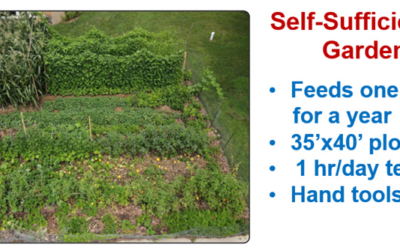
Right, up to a point. It would indeed be impossible to feasibly produce enough wheat or rice in home gardens to come even remotely close to the industrial volume. Growing, harvesting, threshing, and processing either of those grains by hand is just prohibitive for the average gardener, except in small amounts. However, it is quite easy to grow your own corn and beans. And yes, they can produce enough calories and protein to fill out a balanced diet for one, for a year, on a 35’x40’plot, in an hour a day, using hand tools only. Besides, rice and wheat are such vastly consumed staples it would be culturally wrenching to replace them at scale by growing them in gardens, even if the required re-allotment of production from industrial ag fields to urban and rural gardens could somehow be managed. However, garden-grown corn can be, at yields equaling or exceeding those of industry, individually as well as collectively6, as can dry shell beans. And they can be scaled massively.
Most importantly, because of close proximity to personal care, it would be much easier to address climate change catastrophes with gardens than with industrial agriculture, in part because at the collective level gardens use land, water, and energy far more efficiently, and don’t depend on chemical fertilizer and pesticides squeezing through the Strait of Hormuz. Now, if your garden gets completely submerged by a flood or burned up in a fire, your house will likely not remain habitable, so that’s a different story. But climate adaptation varies a lot depending on the scale at which it’s assessed—individual gardens in a stricken area vs a national network of hundreds of millions of self-sufficiency gardens—and whether your house remains livable.
Consider an extreme example: the aftermath of hurricane Helene in the Asheville, N.C. and surrounding area in 2024, where I grew up. In Asheville, it wiped out all services, including water and food, for several weeks. And even gardens in the flooded areas were rendered unusable for months, until they could grow new crops. But after about a month or so, grocery stores outside of the flood zones were back in operation. So, a win for the IFS over gardens? For Asheville, at this time scale, I’d say the answer is a partial yes, though much less so for surrounding, and especially isolated rural areas. Besides, some large Asheville grocery stores didn’t reopen for months. However, properly maintained self-sufficiency gardens provide continuous storage of your harvest, in your house, so that you always have plenty of food on hand. By contrast, grocery stores run out within hours of a disaster hit. Or even just the threat of one. Yet there’s even more to the story. In Asheville’s case, water and other services were also down for the count (potable water for two months!), but with gardens you would have had your own dry and canned groceries to use. Of course, without power, frozen goods would thaw out within a couple days. That’s why canning and pickling are the most dependable options for storage of perishables. Easily stored dry harvest like root crops and winter squash are also good options.
Now take a different kind of disaster: the LA fires. Houses destroyed, no chance you’re going to go back and plant anything in a burned-out yard. People had just to flee for their lives, presumably to some temporary lodging where they had access to grocery stores. So again, industrial food comes through, at least in the short term for those who had to leave the affected areas. Which is still no match for what would amount to a nation-wide strategic food reserve supplied by self-sufficiency gardens, once much bigger, compounded disasters begin to seriously overlap.
The most compelling factor
Even if you still argue that gardens can’t possibly replace industrially produced corn, rice, wheat, soy, and other major staples, it’s a moot point. The reason is that environmental disasters, as I’ve repeatedly shown in the NOAA graphic below (it bears re-emphasizing, as even ag economists and food system analysts continue to ignore its implications), are accelerating at an exponential pace, especially since 20027. You can’t overemphasize it, since crops worldwide are already struggling from rapidly increasing levels of heat, floods, draught, fire, and depleted water.
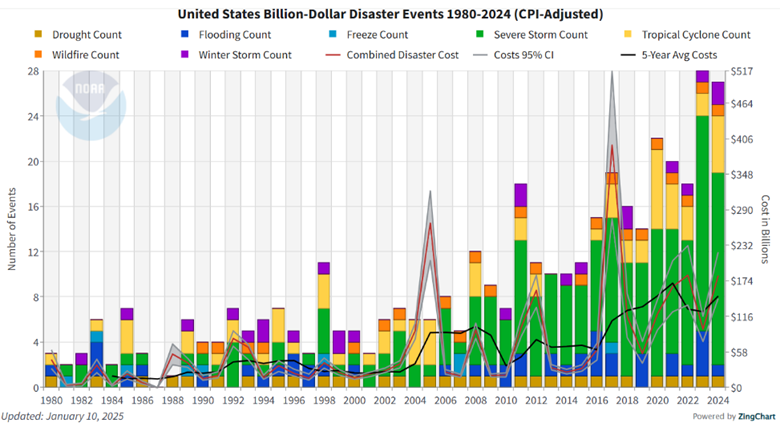
Amazingly, the preponderance of food system mega-studies and reviews, including the most recent one, in 20268, fail to take this upward-rocketing slope into account. Rather, they assume that the disasters will continue to plod along at the more or less flat-line rate of 1980-2002, rather than what the record since 2002 clearly shows. Despite that abject failure, they still conclude that the industrial food system, even with proposed improvements, will fall well short of feeding an expected 10 billion people by 2050.
Now, imagine environmental disasters continuing their 2002-2004 exponential increase through 2050, as climate models and NOAA predict. You don’t have to mount yet another multiple-year, 20-author mega-study to see that already-faltering industrial agriculture simply cannot adapt to another 24 years of a rapidly rising disaster trend. In other words, at some point well before 2050, industrial food production of the world’s food staples will be drastically reduced. Yet ag economists and food system analysts have been strangely unwilling to consider how industrial food production would—if it could—cope with that upwardly explosive curve. I’d not even seen them try until just a few days ago, when a comprehensive study at Kings College London8 reported that:
“. . . current planning tools have a blind spot when it comes to understanding how extreme the worst events could be. They say the what-if scenarios now widely used in risk assessment are not designed to identify, and therefore prevent, worst possible outcomes, such as greater death tolls and more severe impacts on infrastructure and people’s health.”
Bingo. Exactly what I’ve been warning in this space for some time. Maybe now, in their effort to double the food supply by 2050, planners will begin to incorporate the rapid acceleration of climate change disasters into their proposed solutions to food security. That is, rather than continuing to tout naive tropes that have never worked at scale over the long term. Such as reducing meat consumption or food waste, or fixes that would take decades to develop and implement globally, like grossly boosting cropland or yields. Not. Going. To. Happen.
So, arguing about whether household gardens can or cannot replicate global wheat, rice, corn, and soy production is ultimately a moot point. It will be climate change disasters that decide the matter, and it won’t be in favor of business-as-usual production by industrial agriculture or its effete fixes. Fortunately, we can replicate corn and bean production, and also other calorie- and protein-rich garden crops, as indicated by both my research at the individual scale, and the Russian experience at the collective mass scale. Implementing it will increasingly become a weather-driven imperative.
1Riccariadi, et al., 2018. How much of the world’s food do smallholders produce? ResearchGate. https://www.researchgate.net/publication/325405959_How_much_of_the_world’s_food_do_smallholders_produce
2Lowder, et al., 2021. Which farms feed the world and has farmland become more concentrated? World Development. https://www.sciencedirect.com/science/article/pii/S0305750X2100067X
3Wilson, R.T. 2003. The environmental ecology of oxen used for draught power. Science Direct. https://www.sciencedirect.com/topics/agricultural-and-biological-sciences/draft-animal
4A Growing Culture. 2022. Can small-scale farmers feed the world? Local Futures. https://www.localfutures.org/can-small-scale-farmers-feed-the-world/
5Sharashkin, L. 2008. The socioeconomic and cultural significance of food gardening in the Vladimir region of Russia. PhD dissertation, University of Missouri. http://naturalhomes.org/img/food-gardening-russia.pdf
6Fisher, D. 2021. Just grow it yourself – Home gardens outshine industrial food. Beyond Publishing.
7NOAA. 2025. National Centers for Environmental Information (NCEI). U.S. Billion-Dollar Weather and Climate Disasters. https://www.ncei.noaa.gov/access/billions/, DOI: 10.25921/stkw-7w73
8Gibson, M. et al., 2026. Food systems transformation would reshape global agriculture. Nature. 657, pages156–163. https://www.nature.com/articles/s41586-026-10775-2?fromPaywallRec=false
9Mathews, T., et al. 2026. Discovering catastrophic weather risks. Nature Sustainability. https://www.nature.com/articles/s41893-026-01929-1

0 Comments