

Very different, but intriguingly overlapping.
Let’s begin with a shoutout for the first perspective: the heroic efforts of Chris Jones for coming to within a hair of being Iowa’s next State Secretary of Agriculture, garnering 49% of the vote. That is a stupendous achievement. However, the power structure behind dirty water in Iowa is still anti-heroically monumental: 1) The statehouse still has a Republican majority; 2) We still have Mike Naig as Secretary of Agriculture; 3) New Democratic governor Rob Sand has gone easy on dirty water policies; and 4) the corporate behemoths behind industrial agriculture are still a political, economic, and social juggernaut. Together, these forces will quietly fight tooth and nail to prevent any significant changes in state and federal policies that would improve Iowa’s water quality any time soon. Let the great lip-service, foot-dragging charade begin.
My take is that such improvements will be so incremental—even though Chris did move the needle a bit by educating the public and water-quality gate-keepers—that larger forces will render them almost meaningless. Primary among those forces is climate change disasters, which I’ve been harping on for months now. The late Fred Kirschenmann, former director of the Leopold Institute for Sustainable Agriculture, said that industrial ag will change only when it collapses. I agree. And climate disasters are what will bring it to its knees, long before incremental shifts in water policy get any meaningful traction. At that gradually cascading crash point, the heavily polluting industrial agriculture practices responsible for our current abysmal water quality will by default be forced to discontinue business as usual. Then, just when we’ll be struggling with much more frequent and intense climate crises, real policy change will happen. So here is my latest attempt to bring the increasingly formidable force behind such change into more compelling and sharper focus.
A Climate / Food Security Problem, and a Novel Solution
We have an existential dilemma. Actually, a multi-layered dilemma.
First, serious climate change is happening, but the world has yet to even slow it down, let alone stop or reverse it.
Second, to feed an expected 10 billion people by 2050, we need to produce 50% more food than we do now.
But third, feeding that many by then would require, by current production means, further worsening the already accelerating pace of climate change disasters.
Fourth, the solutions global thinkers and institutions promote have not solved food insecurity, nor have they mitigated carbon emissions, at scale over the long term. Further, their proposed new solutions would require decades to develop and implement.
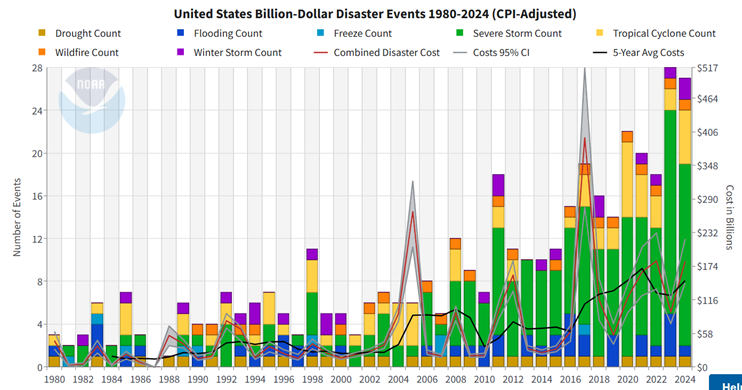
But fifth, we don’t have decades to do that. The pace at which climate disaster events have occurred, as depicted by NOAA for the U.S., was relatively constant from 1980-20011. However, from 2002-2024, it increased exponentially. It’s worth noting that although similar disaster acceleration is happening globally, heat waves caused 70% of all climate disaster deaths in 20252. Heat waves aren’t mentioned in the NOAA chart, since, while contributing to the numbers of disasters and costs, they have not been nearly as drastic as in Europe and elsewhere.

And sixth, said thinkers and institutions have ignored disaster acceleration, blithely continuing to surmise that we still have plenty of time to work things out3. We don’t. Not even close. The result: we’re facing not only ever-worsening climate change, but also ever-decreasing food security. And technically dicey, highly risky, and unproven schemes like carbon capture and removal4 would—again—take far more time to ramp up globally than we have.
So, what to do?
The first step would be for the Big Thinkers to acknowledge the reality of climate change acceleration from 2002-2024. That might make them more open to thinking outside the echo-chamber box of failed solutions. To make it easier for more people—not just the experts—to see it, I’ve provided an extrapolation of the 2002-2024 portion of the NOAA curve to 2050 (lower left; blue = 95% confidence interval).
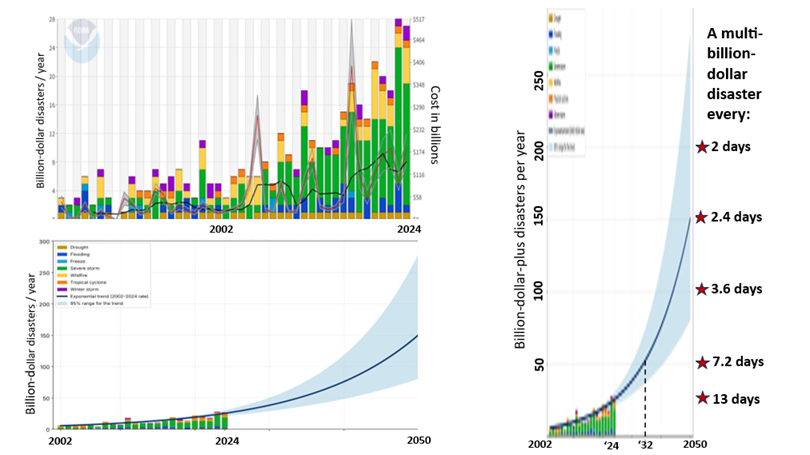
However, the initial version renders a 2002-’24 curve so modest no one would realize how alarming it is. Therefore, I resized the flattened NOAA graphic to its original vertical-to-horizontal axis ratio, then fitted it into the extrapolation proportionately (far right). This makes it much easier to visualize how fast U.S. climate change disasters would accelerate over the next 24 years at the 2002-’24 pace. Note that at this rate, billion-dollar disasters would increase from 27 in 2024 to about 150 a year by 2050.
That would mean a rise from one disaster every 13 days in 2024 to one every 2.4 days in 2050. This would be well within the range of what’s now being called “compounded” events—disasters overlapping, in rapid succession. The cost of these events so far has ranged from a $billion or so per event up to, for example, the 2024 Helene hurricane, which cost $80 billion. With the number, intensity, and cost increasing exponentially, how much compounding can we take? At what point in time will the government, the insurance industry, and our way of life in general buckle and fail unless we start doing things quite differently? Note that by 2032—just a month over 7 years away—disasters would be happening about once a week at the current pace. Could we cope with a multi-billion-dollar event that often? Heavens, as of 2026 we’re still recovering from many previous disasters years after they happened. Could we deal with a new one every other day (well within the 95% confidence range) in 2050? Extremely unlikely.
A genuine solution
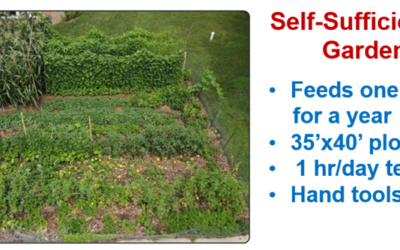
Clearly, a real solution to this multi-layered, existential dilemma requires bold new thinking. That would mean implementing a practice that would relatively quickly (within a couple years) begin to take effect. When fully implemented, it would have the potential to substantially lower carbon emissions in the near term, significantly mitigating climate change while making it possible to feed 10 billion by 2050. Here’s how a parallel self-sufficiency garden food system would accomplish that.
The backdrop: Industrial agriculture consumes 40% of the land, 70% of the water, and 25% of the energy we use. Further, it generates 25% of the world’s direct carbon emissions. Even a partially implemented self-sufficiency garden food system, because it’s so much more efficient—by four major measures of whole-system efficiency —would greatly reduce natural resource use and carbon emissions while producing food far more efficiently.
Implementation at scale would happen relatively quickly, with little need for massive research and infrastructure development. To wit: the WWII “victory gardens” produced 40% of U.S. vegetables on 20 million gardens, within a couple years, by amateurs, with minimal training, supplies, and technology. Because of close proximity to personal care, gardens are much more resilient to climate change disasters than the ponderous, 1,500-mile-long industrial food chain. In addition, home production and storage of self-sufficiency garden produce would establish a much-needed national food reserve as a climate buffer. That it can scale to hundreds of millions has been indicated by Russian household gardens, which in 2008 provided half of the country’s food on just 3% of its agricultural land. Most importantly, the resulting reduction in carbon emissions would significantly mitigate climate change.
It’s a climate change and food security win all around: simple, feasible, economically viable, and compelling at scale. In the meantime, good luck on incremental policy shifts.
1NOAA National Centers for Environmental Information (NCEI). 2025. U.S. Billion-Dollar Weather and Climate Disasters. https://www.ncei.noaa.gov/access/billions/state-summary/US
2Wright, R. 2026. Heatwaves are the worst weather for our health and the economy: Spain pays the highest price in Europe. Euronews. https://www.euronews.com/2026/11/17/heatwaves-are-the-worst-weather-for-our-health-and-the-economy-spain-pays-the-highest-pric
3Sanyal, S. and Pradbhu, J. 2026. Will we go hungry? – Practical ways to ensure global food security. Cambridge University Press.
4Worth, K. 2026. Why Is the World Still Counting on Unproven Carbon Capture Technology? Propublica. https://www.propublica.org/article/carbon-capture-and-storage-climate-models

0 Comments